
A Spark in Macon
From Reparations to Charter Reform

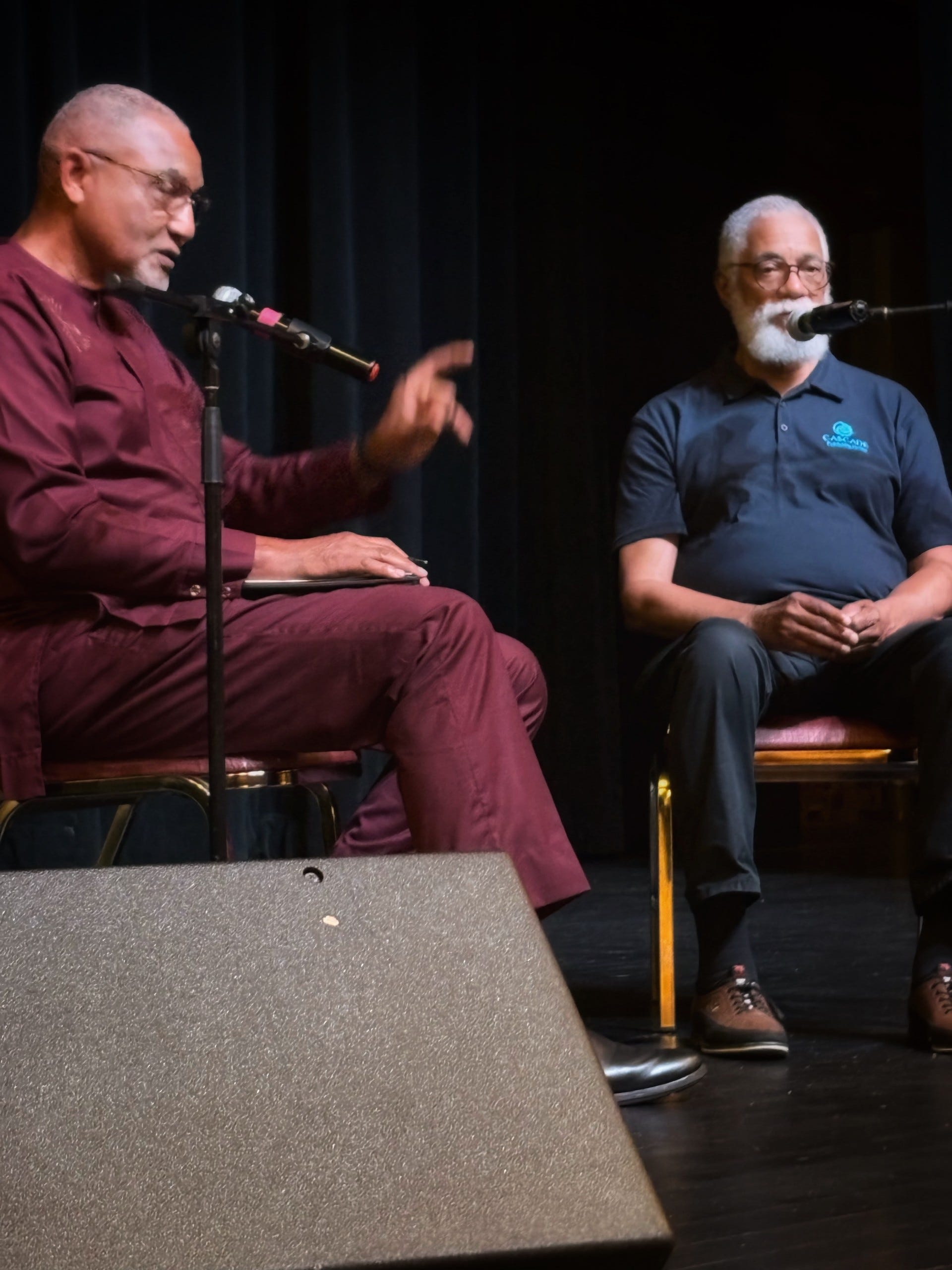
Photo © 2026 Cascade Publishing House
What happened in Macon this week was supposed to be a conversation about Juneteenth, the Fantasy Five, and the long arc of Black history in Middle Georgia. But the room had other plans. What unfolded was something deeper, a free flow of ideas that moved from memory to strategy, from history to power, from reflection to resolve.
Former Mayor C. Jack Ellis and I began by tracing the familiar contours of Black struggle in Macon: the weight of enslavement, the fight for voting rights, the resilience of a people who have always found a way forward. But as the discussion opened, it became clear that the audience wasn’t content to stay in the past. They wanted to talk about the present, and more importantly, the future.
One of the most striking moments came when Mayor Ellis spoke plainly about reparations. He didn’t speak in abstractions or distant hypotheticals. He pointed directly to Mercer University, which owns the mansion of Georgia’s largest enslaver. He said that if Macon is serious about justice, then Mercer must be part of that conversation. It was a bold statement, but it resonated because it was rooted in place, in history, and in truth. Ellis boldly proclaimed that the Peyton Anderson Foundation should participate more in the development of Macon’s Black neighborhoods because Peyton Anderson owned the Macon Telegraph. This institution enriched itself through advertisements from those engaged in the buying, selling, and capture of humans who ran away from enslavement.
From there, the conversation shifted to the structure of local power. Two sitting commissioners revealed that they cannot place items on the agenda without the mayor’s approval. That revelation changed the temperature of the room. It exposed a charter that concentrates authority in ways that weaken democratic participation and limit the community’s ability to shape its own future. I suggested that Macon consider a new charter, moving toward a strong commission with a weak executive, a model that distributes power more equitably and gives citizens a clearer voice in their own governance.
What began as a historical reflection became a strategic conversation about political agency. People wanted to know how the Black community in Macon could gain more leverage, how the charter could be changed, how leadership could be cultivated, and how a new vision for the city could take root. It was not a Juneteenth Commemoration of complaints. It was a historical celebration of clarity.
And the work did not end when the program concluded. Kimberlyn Carter, a political operative of note, gathered Mayor Ellis, me, and about ten others for dinner at The Bear Tavern, an upscale eatery owned by an African American doctor. Over plates and conversation, we continued the dialogue, plotting, planning, talking openly about recruiting a candidate for next year’s mayoral race, examining the global political landscape, and watching the USA and Australia compete in the World Cup. It was the gathering where ideas breathe, where commitments form, and where the next steps begin to take shape.
People left that table with a sense of purpose. Several told me they were inspired, not by rhetoric, but by the realization that Macon’s future is not fixed. It can be shaped. It can be claimed. It can be built. The town’s White mayor can’t posit that the time is right for another Black mayor, and he is going to hand-pick that Black person and expect responsible Black leadership to say, “Yes, Sir, boss, just let us know who you want.”
What happened in Macon was more than a Juneteenth Observance. It was the beginning of a movement, quiet, grounded, and rooted in the belief that a community can change its own destiny when it gathers, speaks honestly, and refuses to let the conversation end.
And from what I saw, the conversation in Macon is just getting started.
Our small towns have always been laboratories of democracy. This is where hope and creativity emerge. Bravo Macon.
Important story - people are hungry for activism. I can hope that other cities showed the same.