
Robert Lewis Brown
The Architect Who Designed My Voice

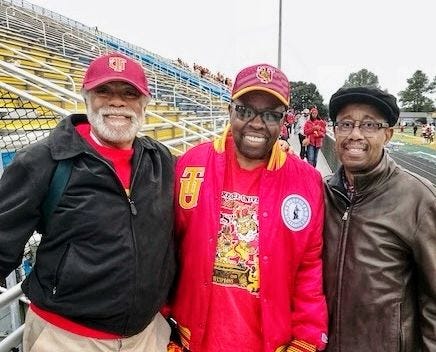
From Left to right, Harold Michael Harvey, Larry Sankey, and Robert L. Brown, Jr. at the 2017 SIAC Football Championship game at Fort Valley State University. This was the last time the 1973 Campus Digest trio got together.
Some people enter your life quietly and end up shaping the entire arc of who you become. For me, Robert Brown was one of those people. We met as students at Tuskegee Institute in the early 1970s, two young men trying to find our voices in a world that was changing faster than we could name. Robert found his voice early. He carried it with a kind of gentle authority, a bright smile, a slow, unhurried gait, and a way of speaking that made you lean in, not because he demanded attention, but because he deserved it.
Robert was my friend, my classmate, my brother‑in‑spirit. But he was also my first editor. He saw something in my writing before I dared to claim it. He invited me to write a weekly column for The Campus Digest, the student newspaper he helped shape with his steady hands and sharp mind. He named the column “Slowly,” and in that single word, he captured both the pace of my thinking and the intention behind it, to slow the campus down just enough for us to consider who we were becoming.
That was Robert’s gift. He slowed you down, not with force, but with presence.
Kindness was his default setting. Brilliance was his quiet engine. Humor was his bridge. Integrity was his spine. Generosity was his way of moving through the world.
And all of it was wrapped in a steadiness that made you feel like you could trust him with your words, your questions, your uncertainties, and he would hold them with care.
What I remember most about Robert is that he had a way of making you feel seen without ever making a show of it. He didn’t rush you. He didn’t talk over you. He didn’t try to impress you. He created enough space for you to arrive as yourself.
I think about the afternoons in the Campus Digest office, when the rest of the campus was buzzing with the urgency of youth, and Robert moved through it all with that slow, deliberate gait of his, as if he refused to let the world dictate his pace. He would lean back in his chair, hands folded, listening as I read a draft aloud. He never interrupted. He never imposed. He waited until I finished, let the silence settle, and then offered a single sentence that cut straight to the heart of what I was trying to say.
He didn’t edit my writing so much as he edited my thinking.
There was a day, I remember it clearly, when I brought him a column, which I wasn’t sure about. The column, titled “On the Evil in the Room,” temporarily stalled the Institute’s desire to have Tuskegee Institute designated as a National Historic Site. I told him it felt too simple, too quiet, too small. He read it, nodded slowly, and said, “Sometimes the truth doesn’t need to be loud to be heard.” That was Robert. He believed in the power of clarity over volume, presence over performance.
Another memory: walking across campus with him on a warm Alabama evening. Students were rushing to meetings, to rehearsals, to study groups. Robert walked as if he had all the time in the world. And as we talked, he asked me a question I wasn’t expecting, not about classes or deadlines or campus politics, but about what I wanted my life to mean. He asked it gently, without pressure, as if he were handing me a key and trusting me to decide whether to use it.
On another occasion, when I was contemplating where to establish my law practice, I met with Robert in his architectural office in Decatur. He encouraged me to set up office in Decatur, then Robert asked me where I wanted to be in five years. He always encouraged me to look at least five years into the future. I settled in Peachtree Center, downtown Atlanta, as a country lawyer, trying to make it in the big city.
That was his gift. He asked the kind of questions that stayed with you.
He carried humor lightly, too, a quick smile, a quiet laugh, a way of easing tension without dismissing the seriousness of a moment. He could make you feel better without making you feel small. He could challenge you without making you defensive. He could guide you without ever taking credit for the direction you chose.
Robert didn’t just publish my words. He helped me hear them. And in doing so, he helped me hear myself.
As I sit with the news of his passing, what rises in me is not sorrow alone, but gratitude, deep, steady gratitude for the way Robert moved through this world and my life.
He didn’t push. He didn’t posture. He didn’t perform.
He offered presence. He offered clarity. He offered a kind of gentle, unwavering integrity that made you want to be a better version of yourself, not because he asked it of you, but because he lived it so naturally.
Robert was the kind of friend who left you better than he found you. The kind of editor who helped you hear your own voice. The kind of human being whose influence continues long after the conversation ends.
I carry his questions with me. I carry his steadiness. I carry the quiet confidence he placed in my writing at a time when I didn’t yet know what it could become.
And now, as I honor his transition, I realize that what he gave me, and so many others, was not just encouragement or opportunity. It was permission. Permission to slow down. Permission to think deeply. Permission to trust the truth of one’s own voice.
That is a rare gift. And it is one I will never forget.
Robert Lewis Brown, Jr. walked through this world with kindness, brilliance, humor, integrity, and generosity, and he left it with the same quiet grace he carried through life.
I am grateful to have known him. Grateful to have learned from him. Grateful to have been shaped, in ways large and small, by the man he was. May his steadiness continue to guide the lives he touched.
I remember this day well. You described Brown accurately and eloquently. I am thankful that our paths crossed as three young men and they did not totally diverge.
Beautiful life story about friendship and learning about yourself and others.